Purpose:
Explain the history, key dimensions, and pressure/chamber differences, practical interchangeability, and common use-cases — technical but non-political and safety-focused.
Quick summary (read this if you only want the bottom line)
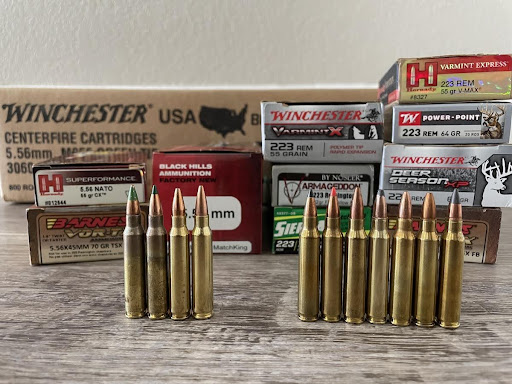
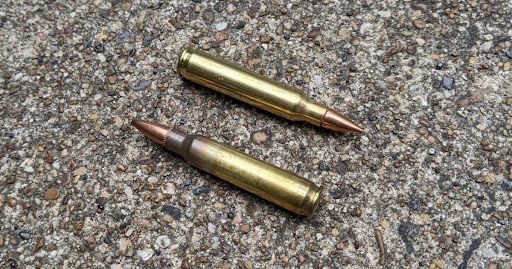
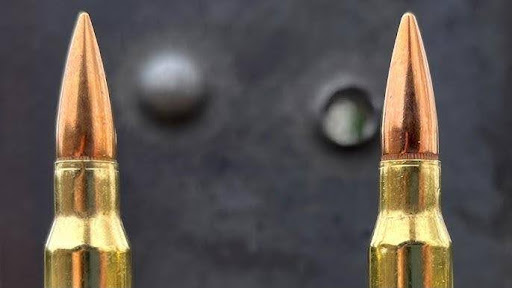
Externally, the cartridges appear almost identical, but their chambers and loading/pressure specifications differ in significant ways.
A rifle marked 5.56 NATO is generally safe to shoot both 5.56×45 mm and .223 caliber commercial ammunition. A rifle marked .223 Rem may not be safe for certain 5.56
NATO military-spec rounds because of throat/freebore/chamber differences that can raise peak pressure. When in doubt, follow the rifle manufacturer’s marking and guidance.
1) Short history — how we ended up with two names
- .223 Remington was developed in the late 1950s and standardized for commercial and sporting use; Remington submitted specs to SAAMI in the 1960s. It became a popular civilian cartridge for varmint hunting and sport shooting.
- The U.S. military adopted a small-caliber, high-velocity round derived from .223; after several evolutions it became standardized as 5.56×45mm NATO (with specific military loadings such as M193, SS109/M855, and others) and adopted by NATO members. NATO standardized magazines and ammunition interoperability through STANAG agreements in the 1980s.
2) Cartridge dimensions and case differences — mostly the same, but not identical
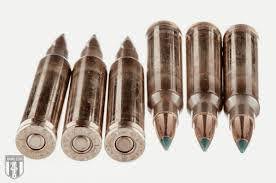
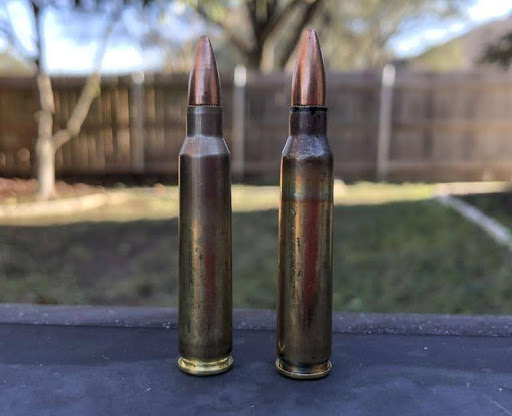
- Measured outside the case, .223 Rem and 5.56×45mm NATO are extremely similar and often interchangeable in terms of feeding from magazines. Many manufacturers produce brass for both that will work in the same rifles. However, small dimensional differences exist in shoulder geometry, neck length, and case wall thickness — and those differences matter mainly when handloading and when combined with chamber throat geometry.
3) Chamber anatomy that matters — freebore / leade / throat
- The critical mechanical difference is the chamber throat (freebore/leade): .223 Remington chambers (as typically spec’d for civilian rifles) often have a shorter, tighter throat, while 5.56 NATO chambers typically have a longer, more generous throat. That extra freebore in a 5.56 chamber allows the bullet to start forward a bit before engaging rifling. That reduces initial seating resistance and helps accommodate higher-pressure military loads.
- Because of that throat difference, firing a 5.56 NATO round in a tight .223 throat can (in some rifles and with some lots of ammo) produce higher peak pressures than the same round in a 5.56-chambered rifle. The extent of that pressure increase depends on exact chamber dimensions, bullet seating, and cartridge lot — which is why some sources recommend caution.
4) Pressure standards — SAAMI vs NATO vs CIP (measurement methods matter)
- SAAMI (U.S. civilian specs) and NATO/CIP (military/international) use different test setups and transducers, so quoted “psi” or “MPa” numbers aren’t always directly comparable without method context. SAAMI lists a standard maximum for .223 Remington; NATO’s proof and service pressure procedures differ (EPVAT testing, proof factors). Because of differing test methods, simple numeric comparisons can mislead unless you note which measurement system is used.
- Practically: NATO loadings (5.56) are developed and tested to operate safely in 5.56-spec chambers and rifles. Civilian .223 loads are tested to SAAMI spec to be safe in SAAMI-spec .223 chambers. There is overlap, and most commercial ammo is safe in most modern rifles, but the standards and testing approaches are different and that underpins the interchangeability caveats.
5) Accuracy and performance differences
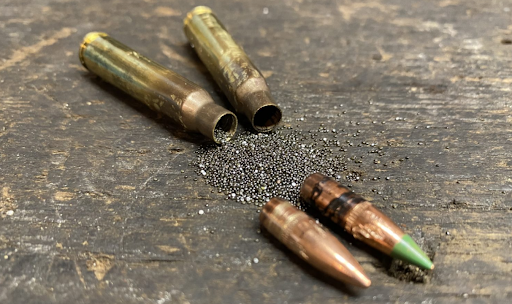
- Freebore length affects accuracy and velocity. Shorter freebore (typical .223) tends to give better potential accuracy because bullet jump to rifling is smaller; longer freebore (typical 5.56 chamber) can yield slightly higher velocities but sometimes at the cost of ultimate precision. Accuracy also depends on barrel quality, twist rate, and ammo/bullet match. Twist rate matters. NATO adopted faster twist rates (e.g., 1:7) to reliably stabilize heavier NATO bullets (the SS109/M855 and later heavier bullets). Many older civilian rifles used 1:12 or 1:14 twists optimized for light 55-grain bullets. When choosing ammo, match bullet weight to barrel twist.
6) Interchangeability: practical rules and safety
- Rifle stamped “5.56 NATO”: generally safe to shoot either 5.56 or .223 commercial ammo. The 5.56 chamber accommodates the throat and pressures associated with military loads.
- Rifle stamped “.223 Remington” (or explicitly .223 REM / SAAMI): exercise caution with 5.56 NATO military-spec ammo, especially older or short-throated barrels. Many shooters and manufacturers advise not to routinely fire 5.56 NATO ball (M855/SS109) out of a rifle labelled .223 Rem without confirming manufacturer guidance. Some rifles will handle it fine; others may show elevated pressures.
- Best practice (safety-first): follow the rifle manufacturer’s marking and owner’s manual. If unsure and you want both accuracy and safety, consider a rifle chambered in .223 Wylde or an explicitly 5.56-spec chamber — Wylde is a popular hybrid chamber that allows accurate shooting of .223 loads while safely accommodating 5.56 ammo.
7) The .223 Wylde and other hybrid chambers
- .223 Wylde (designed by Bill Wylde) is a widely used hybrid chamber that uses the external dimensions of the 5.56 NATO chamber but the .223 Rem freebore diameter and a compromise leade. The result: better accuracy with .223 commercial loads while being safe with 5.56 NATO military loads — a common choice for civilian AR-pattern rifles intended to run both types of ammo.
8) Use cases — what people pick which for, and why
- Military / NATO use: 5.56×45mm NATO (various loadings) — standardized for logistical interoperability and for performance with specific heavier projectiles (SS109/M855 and successors). Designed for service rifles and optimized for reliability in adverse conditions.
- Law enforcement / security: mixed — some agencies use 5.56-spec weapons and ammo for penetration and barrier performance considerations, others use commercial loads chosen for terminal performance and controllability. Choice depends on mission and local procurement.
- Civilian sport, hunting, plinking: .223 Remington is very popular for varminting, target shooting, and general sport because of mild recoil, flat trajectory, and wide ammo availability. For shooters who want to run both commercial match loads and military ball ammo, chambers like .223 Wylde or 5.56 factory chambers are chosen.
9) Handloading and brass considerations
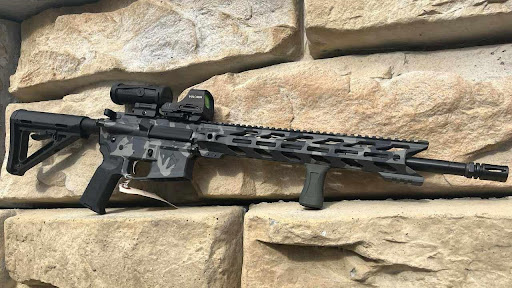
- If you handload, treat .223 and 5.56 brass as distinct in your load data: consult reputable load manuals that list separate data for .223 Rem and 5.56 NATO or note when data is specified for military chambering. Case capacity, case wall thickness, and allowable pressure differ enough to make following published loads and starting pressures essential. Do not assume a load for .223 will behave identically in a 5.56 chamber and vice versa without consulting data and watching for pressure signs.
10) Practical checklist — what to do if you own a rifle or are buying ammo
- Read the rifle barrel/chamber marking and the owner’s manual. Manufacturer guidance overrides general advice.
- If the barrel says 5.56 NATO, you can generally use both 5.56 and .223 ammo. If it says .223 Rem, avoid feeding unknown 5.56 military-spec loads unless the manufacturer confirms it’s rated for them.
- If you want the best of both worlds (accuracy with .223 match ammo and safety with 5.56 ball), consider a barrel chambered .223 Wylde or a modern 5.56 chamber designed with a compromise throat.
- If handloading, use the correct load data and keep an eye for pressure signs (sticky bolt, flattened primers, heavy extraction). Start at recommended starting loads and work up safely.
11) Common myths — busted
- Myth: “5.56 always has higher pressure than .223.”
Reality: The testing methods and chamber contexts differ; you can’t directly compare raw numbers without method context. Sometimes 5.56 military loads run higher, but the main safety issue is throat geometry and how a given round interacts with a given chamber. - Myth: “Never ever shoot .223 in a 5.56 rifle.”
Reality: A 5.56-chambered rifle is generally designed to handle both. The concern is the reverse direction (some 5.56 in .223 chambers). Still, always check manufacturer guidance.
12) Closing / recommended reading
If you want to dig deeper, read SAAMI pressure tables and your rifle’s manual, and look at NATO proof documents for EPVAT testing methods — they clarify how pressures are measured and why the numbers aren’t directly comparable. The National Shooting Sports Foundation (NSSF), reputable ammo manufacturers’ tech pages, and chamber reamer docs (Wylde, SAAMI, NATO) are helpful, practical resources.
Final practical advice (one-sentence)
If your rifle is stamped 5.56, you can generally shoot both; if it’s stamped .223, don’t assume it’s safe for all 5.56 military loads — check the maker or choose .223/.223 Wylde/5.56-rated barrels to cover both safely.
Sources (selected)
- SAAMI — velocity & pressure data and standards.
- NATO AEP-97 / EPVAT proofing guidance.
- NSSF explanation: “.223 vs 5.56 — Are they interchangeable?” (practical safety guidance).
- Ammo.com and RifleShooter technical articles on chamber and throat differences and Wylde chamber