

Introduction
Below is a concise, practical report that explains what shotgun chokes do, how Improved Cylinder (IC), Modified (Mod) and Full chokes differ, when you’d choose each one, how other factors change results, and a simple testing protocol so you can measure exact performance with your gun and loads
1 — What a choke is and what it changes
A choke is a constriction at the muzzle (or a screw-in tube) that controls how quickly the shot column spreads after it leaves the barrel. The choke does two things that matter to shooters:
- Pattern density at range — tighter chokes keep pellets together longer, producing a denser pattern (more pellets striking a given target area).
- Useful range — tighter chokes extend the effective patterning range for hitting small or distant targets; more open chokes give a wider pattern useful at close distances.
Chokes do not change pellet velocity in any meaningful way, and they do not increase lethality per pellet — they simply change how pellets are distributed downrange.
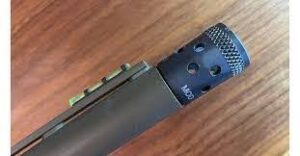
2 — the three chokes: IC, Modified, Full— quick comparison
- Improved Cylinder (IC)
- Effect: Relatively open constriction. Produces a wide, fast-developing pattern.
- When to use: Very close targets, fast-moving birds at short range, upland bird flushing (pheasant/dove at close ranges if birds are close), tactical/home-defense with shot or slugs (many slug loads require cylinder or IC).
- Typical feel: Fast spread, forgiving on pointing errors, less pellet density at longer distances.
Modified (Mod)
- Effect: Mid-level constriction. Gives a balance of pellet density and spread.
- When to use: General-purpose hunting (ducks, pheasants at moderate range), sporting clays where targets appear at mixed distances, many defensive buckshot applications at moderate engagement ranges.
- Typical feel: Versatile compromise — good pattern at moderate distances without being too tight for close shots.
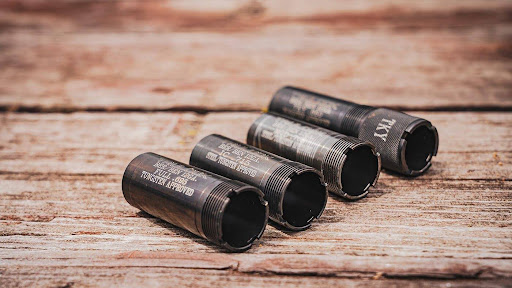
Full
- Effect: Tighter constriction — pellets stay in a tighter cluster longer.
- When to use: Longer shots at birds (turkey often uses very tight “extra full” or specialized turkey chokes), waterfowl at extended ranges (with lead or approved steel patterns), and when maximum pellet density on a small target at distance is required.
- Typical feel: Dense pattern out to longer ranges but can be unforgiving at very close ranges (over-concentration and potential for early pattern gaps if aim or lead is wrong).
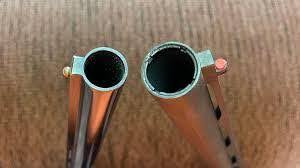
3— What “changes” as you switch from IC → Mod → Full
Switching from IC to Mod to Full primarily changes:
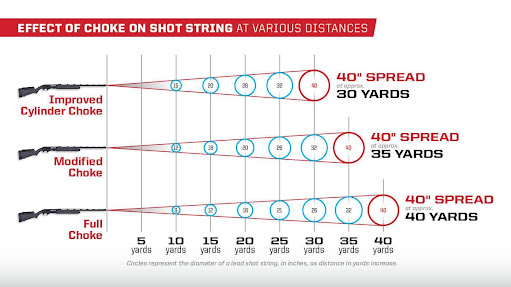
- Pattern diameter at a given distance — IC = widest; Mod = moderate; Full = smallest.
- Pellet density inside a chosen target circle — Full concentrates more pellets into the same area than Mod or IC.
- Effective engagement range — IC effective at very close range; Mod at short-to-moderate; Full extends the effective range for small targets.
- Point of aim considerations — tighter chokes can make POI feel “sharper” for small targets at range (you’ll notice several pellets striking a small cluster); with wide chokes you rely more on pattern coverage.
- Susceptibility to pattern anomalies — some chokes (very full or aftermarket specialty chokes) with certain shot types can show core/edge imbalances — this is why pattern testing with your exact gun + load is crucial.
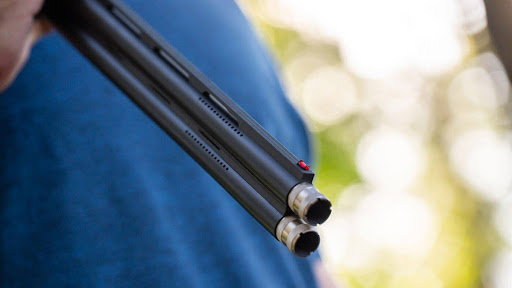
4 — Other important variables (they change results as much as the choke)
Don’t blame the choke first — these factors strongly affect patterns:
- Shot size (pellet diameter): larger pellets have more momentum and hold together differently than small pellets.
- Shot material: lead patterns differently than steel, bismuth, or tungsten — harder/less-dense pellets behave differently through chokes.
- Wad type & payload: plastic wads, sabot design and how many pellets you fire change how the shot column disperses.
- Barrel length & forcing cone geometry: these influence initial shot stability.
- Rifling (rifled slugs) vs smoothbore: rifled barrels for slugs do not pattern shot well — use cylinder for slugs.
- Barrel choke tolerances & wear: older barrels and different manufacturers have varying actual constrictions — “Mod” on one gun may pattern differently than “Mod” on another.
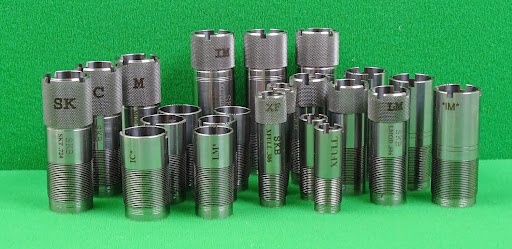
- Skeet/trap/turkey-specific chokes: many manufacturers offer named chokes (Skeet, Improved Cylinder, Turkey, Extra Full) tailored for those tasks — these are optimized constrictions, not universally identical.
Because of all these variables, only real-world patterning with your gun and load tells the true story.
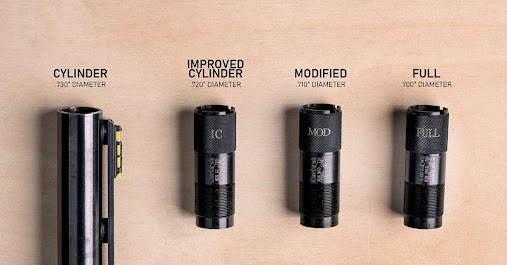
5 — Practical rules-of-thumb / recommended choke by activity
- Skeet shooting / very close birds (under ~25 yds): Cylinder or Improved Cylinder.
- Upland birds (doves, quail) at short ranges (~15–35 yds): Improved Cylinder → Modified depending on typical shot distance.
- Pheasant / Ducks at moderate ranges (25–45 yds): Modified is a common choice; Full if you often take longer shots.
- Trap shooting / long clay targets (distant, straight-away targets): Modified to Full depending on distance and throw. (Many trap shooters use Modified or Full on the second barrel.)
- Waterfowl with steel shot (longer ranges): Modified or Full depending on distance; consult choke manufacturer for steel-rated chokes.
- Buckshot / Defensive loads: Improved Cylinder to Modified depending on expected engagement range; too-tight can clump pellets and reduce effective pattern area for close work.
- Slugs: Cylinder or Improved Cylinder (rifled slugs in smoothbore barrels work best with cylinder). For accuracy with saboted slugs, consult manufacturer; many modern slug barrels or rifled chokes exist but follow the slug type guidance.
- Turkey hunting: Extra Full or specialized turkey choke (very tight) with appropriate shot (heavier, higher-density pellets or sabot/turkey loads) — pattern very carefully at the ranges you expect (often 20–40 yards).
6 — How to pattern your shotgun (quick testing protocol)
This is the single most useful routine — it tells you exactly what your gun + load + choke will do.
- Set up a pattern board: 30″ (≈76 cm) circle of paper is commonly used for 12-gauge patterning; mount it centered at the height of the gun’s sights/stock.
- Distance: use the range you care about — common test distances are 20 yd / 30 yd / 40 yd (18 m / 27 m / 36 m). For turkey test at shorter distances you intend to shoot (e.g., 20–40 yd).
- Aiming point: rest the shotgun in a solid rest (bag or vice) and aim at the center of the circle. Do not swing or move — consistency matters.
- One shot per paper per load/choke combination. Mark the shot and record choke, shot size, load, temp, barrel used (if testing multiple barrels).
- Count pellets or estimate pattern density: either count pellets inside the circle (exact method) or estimate coverage (e.g., “very light”, “about 50% coverage”, “solid core with sparse edges”). Photograph and record.
- Repeat: 3–5 shots per choke/load/distance gives a feel for consistency (mean and variation).
- Analyze: A “good” pattern depends on your aim and target size — for clays you want spread to intersect the target area; for turkey you want a very dense core in a small circle at expected range.
Notes: use the exact ammunition you will hunt with. If using steel shot, test with steel because steel patterns differently than lead.
7 — Interpreting pattern results (what to look for)
- Core vs skirt: A dense central core with thin outer rings is typical of tighter chokes. For some hunting situations (pheasant breast, turkey head/neck) you want a dense core; for close flushing birds you want even coverage.
- Consistent POI: if POI shifts widely between shots, check aim, wad shot/pellet deformation, or barrel/choke issues.
- Shot deformation/clumping: if pellets are deformed (older/cheap shot) or if the wad fails, patterns will be poor.
- Manufacturer differences: screw-in chokes and fixed chokes vary—document which choke tube model and brand you used so you can reproduce results.
8 — Common mistakes & pitfalls
- Assuming one choke fits all loads. Different loads pattern differently; test each.
- Patterning at only one distance. A choke that looks good at 20 yd might be insufficient at 40 yd. Test at operational distances.
- Using the wrong target circle size for your gauge/intent. A 30″ circle is common for 12ga; smaller gauges and specialized tests might use different circles.
- Ignoring pellet material and shot size. Steel patterns differently; very small or large shot sizes change optimal choke choice.
9 — Quick reference table (qualitative)
| Choke | Spread at range | Best for | Notes |
|---|---|---|---|
| Improved Cylinder (IC) | Wide | Close-range birds, dove, quail, home defense, slugs (cylinder/IC for slugs) | Fast spread, forgiving |
| Modified (Mod) | Medium | Versatile hunting (ducks, pheasants), mixed-range shooting | Good all-rounder |
| Full | Tight | Long-range bird shots, turkey (or extra-full/turkey-specific chokes) | Dense core, extends effective range |
Final recommendations
- Decide your primary mission (close-range upland, long-range waterfowl, turkey, home defense). Pick a choke family appropriate to that mission.
- Pattern your exact gun + choke + ammo at the distances you’ll be using. That empirical data is the only reliable guide.
- Use steel-rated chokes for steel shot and follow manufacturer guidance — steel is harder and can damage non-rated chokes.
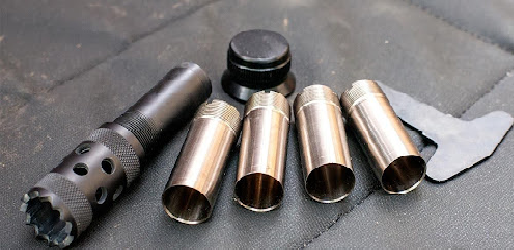
- For multi-purpose use, many shooters keep two choke tubes (e.g., IC and Mod) and swap depending on the expected range; for turkey or long waterfowl work they carry a tighter specialty choke.
- For slugs, use cylinder or an appropriate slug-specific choke/barrel; don’t expect choked barrels to pattern slugs well.

